SaleSystem / Med spa price inquiry scripts
Med Spa Price Inquiry Scripts
A new lead asks, “How much is it?” Give them the clearest answer you can before asking them to book. Use these scripts to explain the cost and help with the next step. They want to know if the fee goes toward treatment? Use the consultation fee replies. Already shared the price? Jump to the price objection replies, copy the email template or get the free team kit.
By SaleSystem · · Updated · Operations
Give a clear answer before offering booking help
A price question is not a reason to label someone a bad lead. They may be checking whether a visit fits their budget or what an offer includes. Help them understand that before moving to the calendar.
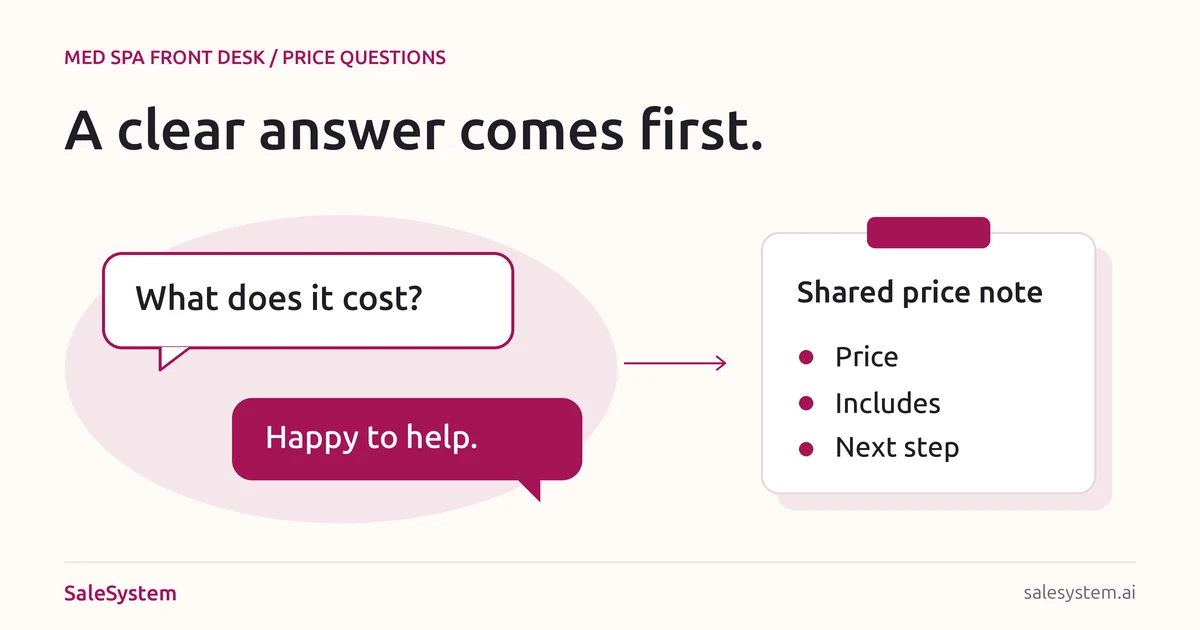
Use this simple order: price, what it includes, what happens next. If part of the total needs a consultation, explain that part. Do not hide a known fee behind “you have to come in.”
These scripts are for new inquiries before a consultation. For a client who already attended, use our consultation follow-up guide. The wording below also works for a day spa: replace the consultation with the facial, massage or other service the guest asked about.
Five ways to answer a price inquiry
Replace every bracket with current, approved details. Use the same plain answer by phone, text or email. A text reply should stay short; an email can link to the full service and terms.
When the service has a fixed price
Hi [First Name], [Service] costs [Price] and includes [What Is Included]. The visit takes about [Length]. [Any Required Extra Fee, or Confirmation That There Is None]. Would you like help finding a time?
Name the service clearly. If the price covers one area, one visit or a set length, say so. Do not make the reader guess whether it is the whole service or only a deposit.
When the total depends on a consultation
Thanks for asking. [Service] is priced [Approved Rate or Range and What It Covers]. Your provider will confirm the treatment plan and total at the consultation, before you decide. The consultation costs [Fee], with [Credit or Refund Terms]. Would you like to know what that visit includes?
If there is no useful approved range, say that the total is quoted after the provider’s assessment. Still share the consultation fee and process. Do not invent a low starting price to get someone through the door.
When someone asks about an advertised offer
Yes, the [Offer Name] is [Price] for [Included Service or Visits]. It applies to [Who Qualifies] through [Real End Date]. [Key Limits or Required Fees]. Here are the full details: [Offer Link]. What would you like to know before booking?
Check the actual ad or page they saw. If the offer ended or does not fit their request, explain the current option plainly. Do not carry an old promotion into a new quote.
When the person says it is more than they planned
I understand. There’s no obligation to book. I can send the service details so you can review what’s included. Would that help, or would you prefer to leave it for now?
Let the answer guide you. Share an approved option only if it fits their question; do not invent a discount or promise financing. If they ask to pause, record that choice rather than treating it as another objection to overcome.
When the desk needs to confirm the answer
I want to give you the right price rather than guess. I’ll check [The Open Detail] with [Team or Person] and reply by [Time You Can Keep]. Would you prefer the answer here or by phone?
Assign that check to a named teammate. If the answer is delayed, update the person before the promised time. “I’ll ask someone” is not a complete handoff.
Does the consultation fee go toward treatment?
Answer before you send a booking link. Start with what the client pays to book, what they owe at the visit, and what happens to that money if they go home without treatment. Use the terms for the visit they picked. A consult with a different provider may have a different fee.
If the fee pays for the visit only
“The consult costs [fee]. You pay [amount] when you book and [balance] at the visit. That covers your time with [provider]. You can leave with the plan and decide later. If you choose treatment, we price it separately.”
If some or all of the fee counts toward treatment
“The consult costs [fee]. If you choose [eligible service], [credit] of that fee goes toward your bill. To use it, you need to [book by or have the visit by the actual date].”
For example, if the spa credits a $50 fee toward a $300 service, the client owes $250 for that service after the credit. If the fee only pays for the consult, the same service still costs $300. Use your own prices and leave out the deadline if there isn’t one.
“What if I leave without treatment?”
Tell them what happens under your policy: the fee pays for the visit, a credit stays available, or an amount is refundable. Be specific about which applies. If the booking page also asks for a deposit, explain whether it is part of the fee or a separate charge. Don’t count the same payment twice.
If the terms are unclear, try: “You asked whether the fee still counts if you come back next month. I’ll check that with [name] and text you by [time]. You can decide after you hear from me.” See how your team can pick up that callback in SaleSystem.
A unit price is not a total
If a service is priced per unit, area or session, name that unit every time. A rate for one unit does not tell the person what their full visit will cost.
For a medical treatment, the front desk should not guess the number of units or sessions someone needs. Use the approved rate, explain how the provider sets the plan and state the consultation fee. Send medical suitability or treatment questions to the clinical team.
The same rule helps day spas. “From [Price]” should explain which service length or option that price covers. If a longer visit or add-on costs extra, put that detail beside the price.
What to say after the client hears the price
A second price question can mean the person needs a detail, wants to compare options or cannot spend that amount. Listen to what they say. You do not need to turn every concern into a discount or another pitch.
“Another spa quoted less”
Thanks for letting me know. Our price is [Price] for [What It Covers], including [Included Items]. If you’d like, I can explain those details so you can compare the two offers. Is there a part you’d like me to clarify?
Explain your own offer. Check whether the other amount is per unit, per visit, a deposit or a package before treating the totals as equal. Do not guess what another spa includes or claim its care is worse.
“That is too expensive for me”
I understand. You do not need to book now. If it helps, I can explain what is included or send the details for later. Would either be useful?
If the client asks for a lower-cost option, share only current options your team is allowed to offer. Keep any treatment change with the provider. If they say no, thank them and end the sales follow-up.
“Can you match that offer?”
Our current price for [Service] is [Price], with [Included Items]. [Our Approved Price-Match Answer]. I can confirm any offer terms you’re unsure about before you decide.
Use the real policy in the bracket. If a manager must decide, say who will check and when you will reply. An approval request is not a promised discount. Keep the confirmed answer in the same conversation.
“I need to think about it”
Of course. Is there anything you’d like me to clear up first? You can reach us here when you’re ready. If you’d prefer a check-in later, tell me what day works.
Only set a callback when the person asks for one. Record the agreed day and channel. “Thinking about it” on its own is not a request for repeated calls.
A quick comparison check for the desk
- Price basis: Is the amount a full price, a rate, a deposit or a starting price?
- Included service: What visit, length, area or package does it cover?
- Other costs: Are any required fees still due?
- Offer terms: Who can use it, and when does it end?
- Open question: What does the client still need to know?
Answer those points from the approved offer. For the client's medical plan or suitability, ask the clinical team rather than filling a gap with a sales promise.
A price reply email clients can save
Use this when someone wants the details in writing. Fill every bracket and remove any line that does not apply. Keep the price answer near the top.
Subject: [Service] price and visit details at [Med Spa]
Hi [First Name],
Thanks for asking about [Service]. The price is [Price and Basis]. It includes [What Is Included]. [Required Extra Costs, or Confirmation That There Are None].
[If a Consultation Is Needed: The consultation costs [Fee]. Your provider will confirm the plan and total before you decide. [Credit Terms].]
The booking terms are [Deposit and Key Change Terms]. You can read the full details here: [Service or Offer Link].
You asked about [Open Question]. [Confirmed Answer, or Who Is Checking and When We Will Reply].
If you’d like help choosing a time, reply here or use [Booking Link]. I’m happy to answer any questions first.
[Name]
[Med Spa and Contact Details]
Use the correct location link and a monitored reply address. Keep the usual business and required opt-out details in the footer. When the client replies, answer that question before sending another booking prompt.
Give your team a price reply kit
No email required. The editable text file includes the email, budget and comparison replies, a shared price sheet and a next-reply note. Fill it with your own approved prices and terms before the team uses it.
Practice a comparison across two shifts
A caller asks about an offer, then emails that another spa quoted less. The first teammate saves the price already shared and the caller’s question about what is included. A second teammate reads both, confirms the inclusion and sends the answer.
If the caller wants a Friday check-in, give that task an owner and due time. If they decline, close the sales follow-up. If they book, check the saved appointment and focus on the visit details. A reply sent and a visit booked are different outcomes.
SaleSystem’s shared lead follow-up tools help your team keep the question, earlier reply and next task together.
Keep one price note the whole desk can use
A shared note keeps the answer steady when shifts change. Have the person who owns pricing check it whenever a fee or offer changes.
Service or offer: [Exact name and source link]
Current as of: [Date checked and person who checked it]
Price basis: [Total, per unit, per area or per session]
Includes: [What the client gets]
Extra costs: [Required fees and optional add-ons]
Consultation: [Fee, what happens and any credit terms]
Booking terms: [Deposit, change and refund terms]
Unknown details go to: [Named person or team]
Client’s open question: [What still needs an answer]
Next step: [Owner, agreed channel and due time]
Example: a price question crosses two shifts
A lead texts about an offer near closing. The first teammate shares the approved price and terms. The lead then asks whether a specific add-on is included.
Staff leave that exact question with the record and assign it to the person who can confirm it. The morning team reads the first reply, answers the open question and offers booking help. The client does not get a second sales pitch or a different price.
Med spa lead follow-up software keeps those messages and staff tasks close together. Use your shift handoff for questions still open at closing.
If the answer is followed by silence
First check that the reply actually answered the cost question. “Book a consult” alone may leave the person no closer to a decision.
If your contact rules allow a follow-up, make it about help rather than urgency:
Hi [First Name], did the details answer your price question? I’m happy to help if anything is unclear. No need to decide today.
If they want more time, ask whether they want a later check-in or would rather contact you. If they decline or opt out, close the follow-up. Do not turn a quiet conversation into daily price offers.
Review common questions with the owner. If staff keep explaining what a package includes, improve the offer page. If price answers keep waiting on one person, give the desk a clearer approved note.
Make the next reply easier for your team
SaleSystem puts calls, texts, emails, client history and follow-up tasks together. Your desk can find what was quoted, answer the next question and help the person book without starting over.
Explore SaleSystem’s med spa lead follow-up tools. Marketing includes CRM, conversations and workflows; booking and payments come with the Operations Complete add-on. See med spa plans, or day spa plans.
During your 14-day free trial, try a price-question handoff with a sample client and your own team’s contact details. Have a second teammate find the earlier answer and finish the open task.
Keep every price question and reply together
Try SaleSystem free for 14 days. Manage your leads, follow up with clients and book appointments in one place.